
IH Ceramic Cookware: A New Opportunity for Electric Kitchens
November 16, 2026
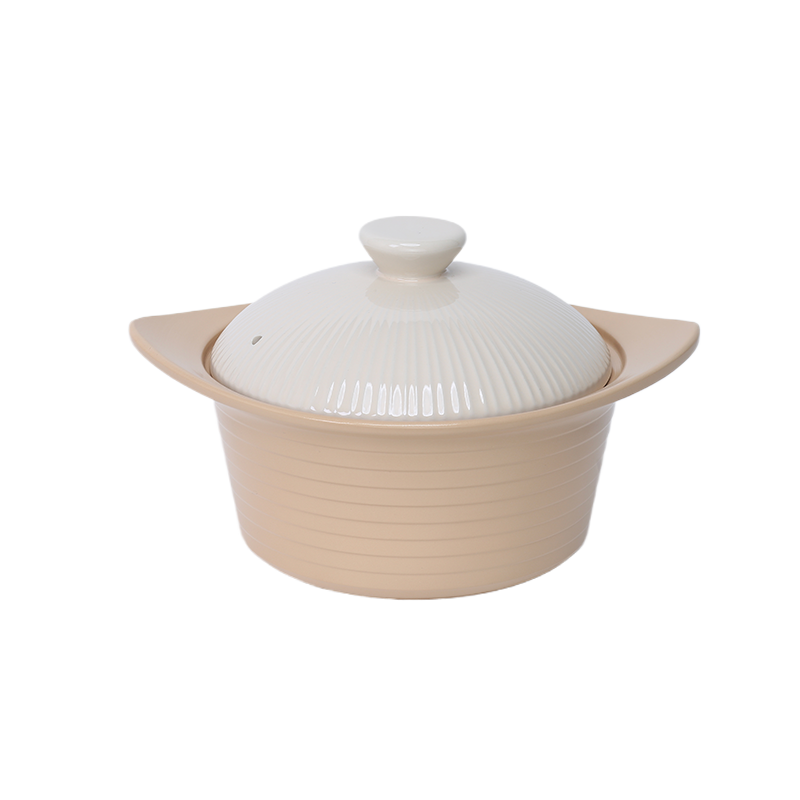
Sunshine IH ceramic casserole, model 6003-11-15-GI. Image from our product catalogue.
Market perspective · Materials & induction · For cookware buyers
The next opportunity for ceramic cookware is not simply a new glaze. It is a place on the induction cooktop.
Ceramic casseroles bring colour, form and a familiar cooking-to-serving experience to the kitchen. Yet a beautiful vessel can lose its place in a cookware range if it cannot work with the customer’s heat source. As kitchens move toward electric cooking, that compatibility gap becomes a product-development question: can ceramic keep its character while meeting a different way of cooking?
Sunshine’s answer is IH ceramic cookware: a specially formulated ceramic body developed for induction, without a separately bonded metal plate beneath the vessel. For brands and importers, the opportunity is a ceramic-led range built around induction use, not another generic pan.
Why traditional ceramic meets a barrier on induction
Heat resistance and induction compatibility are different properties. A conventional ceramic pot may tolerate its approved heat source without being suitable for direct induction heating. Induction relies on a compatible magnetic response in the cookware, rather than a flame heating the pot from below. ENERGY STAR’s buying guidance explains why cookware compatibility matters and identifies suitable metal cookware as familiar examples. [1]
That distinction matters on a retail shelf. “Ceramic” can refer to a ceramic-bodied vessel or to a ceramic-coated metal pan. They are not the same construction. Buyers should specify the body material, food-contact surface and induction design separately.
Three opportunities in the changing kitchen
Electrification creates a reason to rethink the assortment. The IEA identifies electric cooking as one route to reduce reliance on LPG, subject to equipment availability and grid capacity. [2] Meanwhile, NKBA’s 2026 kitchen-trends research points to personalised spaces, natural tones and a stronger connection between cooking and social areas. [3] These are directional signals, not a forecast of ceramic cookware sales.
Keep ceramic in the range
An induction-ready option lets buyers consider ceramic for customers moving to electric kitchens, instead of excluding it at the heat-source filter.
Build a recognisable collection
Coordinated forms, glaze colours and lids can give a private-label range a visual identity beyond a conventional metal-pan assortment.
Connect cooking and serving
A casserole chosen for both preparation and presentation creates a clear merchandising story for shared meals, gifting and tabletop-led ranges.
Low-carbon ambitions are part of the wider electrification discussion, but an electric cooktop does not automatically make a cookware product low-carbon. Electricity supply, manufacturing, product life and actual use all matter. No carbon-footprint advantage for Sunshine cookware is claimed here. IEA electricity-emissions data provides the wider energy-system context. [4]
Sunshine’s approach: start with the ceramic body
Chaozhou Sunshine Technology Development Co., Ltd. develops and manufactures ceramic cookware in Chaozhou, China. Our IH development focuses on the body formulation: incorporating magnetically responsive material into the ceramic body, rather than attaching a separate metal plate beneath the pot.
This approach was described publicly by Sunshine technician Wang Yongtao in an April 2024 Canton Fair report from Chaozhou Publishing, republished by Sina. The interview records the company’s explanation of integrating magnetic material into the ceramic body. It is evidence of that public technical description, not an independent performance test or a finding of industry priority. [5]
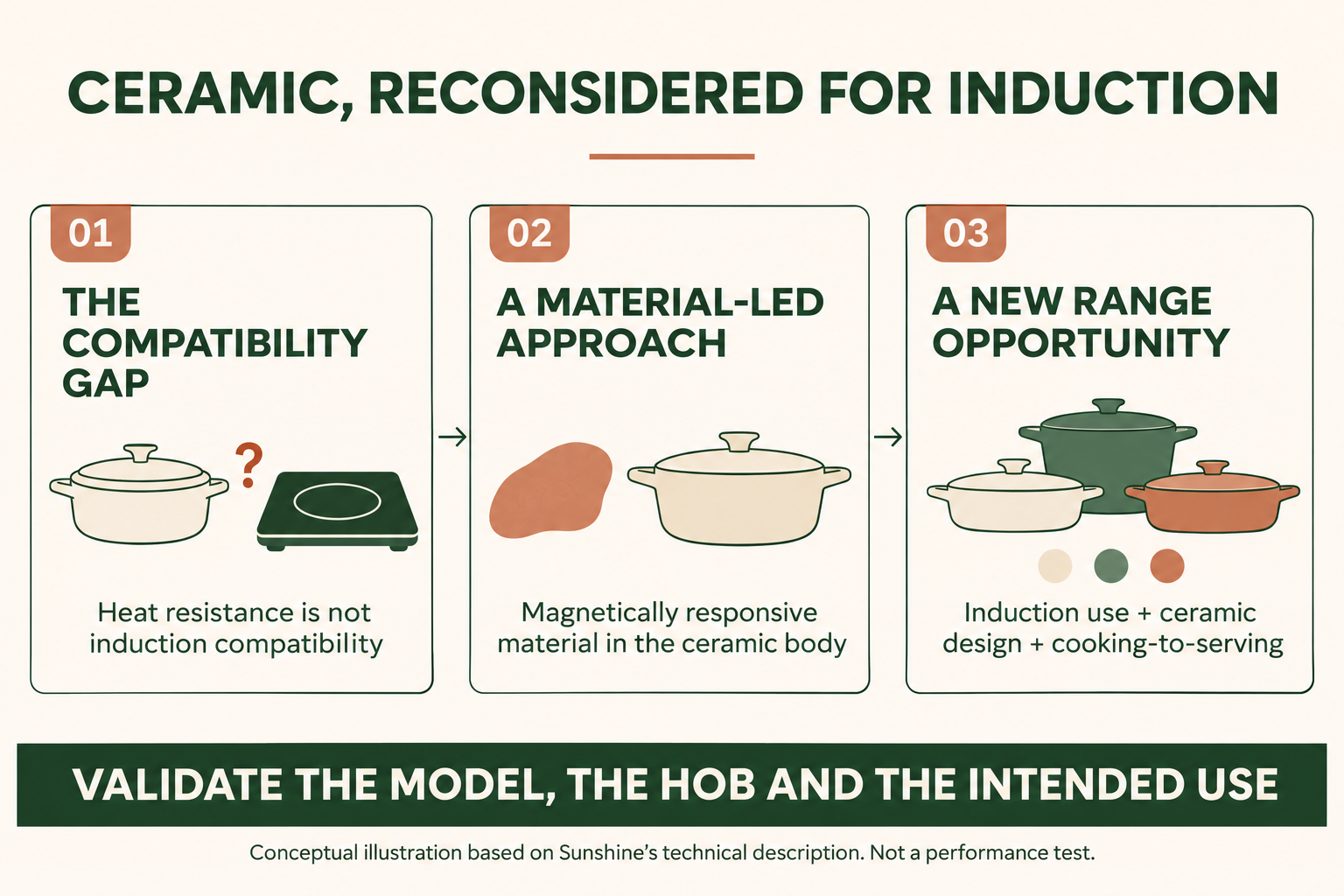
A material-led route to induction cookware
Conceptual development sequence based on Sunshine’s technical description. Not a cross-section, heating simulation or measured performance diagram.
The commercial difference is straightforward: induction compatibility becomes part of a ceramic product-development brief. Buyers can discuss the vessel form, glaze, lid, decoration and packaging as one coordinated range. This does not establish a universal efficiency advantage, guarantee compatibility with every hob, or remove the need for model-specific evaluation. Explore the Sunshine IH technology approach.
Ceramic or metal? Choose for the application.
The useful comparison is not “healthy ceramic versus harmful metal.” Both categories contain different materials and constructions. The right choice depends on the dish, heat source, handling requirements and the finished product’s evidence.
| Buyer question | Ceramic-bodied cookware | Metal-bodied cookware |
|---|---|---|
| Induction use | Requires a suitable IH design. Conventional ceramic alone is not a compatibility claim. | Depends on the alloy or base construction. “Metal” alone does not mean induction-compatible. |
| Range identity | Glazed forms and matching lids support a ceramic-led cooking-and-serving collection. | Alloy, coating, finish and handle design offer a different set of styling choices. |
| Heat response | Assess the actual body, wall thickness and cooking behaviour of the sample. | Assess the alloy, layered construction, thickness and cooking behaviour of the sample. |
| Handling & care | Evaluate impact, thermal-change limits and glaze care against the model’s instructions. | Evaluate coating care, corrosion resistance and handle construction for the selected material. |
| Food-contact safety | Verify body, glaze and decoration against destination-market requirements. | Verify alloy, coating and intended food-contact use against destination-market requirements. |
Material names are not safety certificates. FDA guidance explains that improperly made ceramic glazes or decorations can release lead into food. [6] For a purchase decision, request relevant test records for the finished specification instead of relying on blanket “non-toxic” or “healthier” language.
Turn the opportunity into a focused product brief
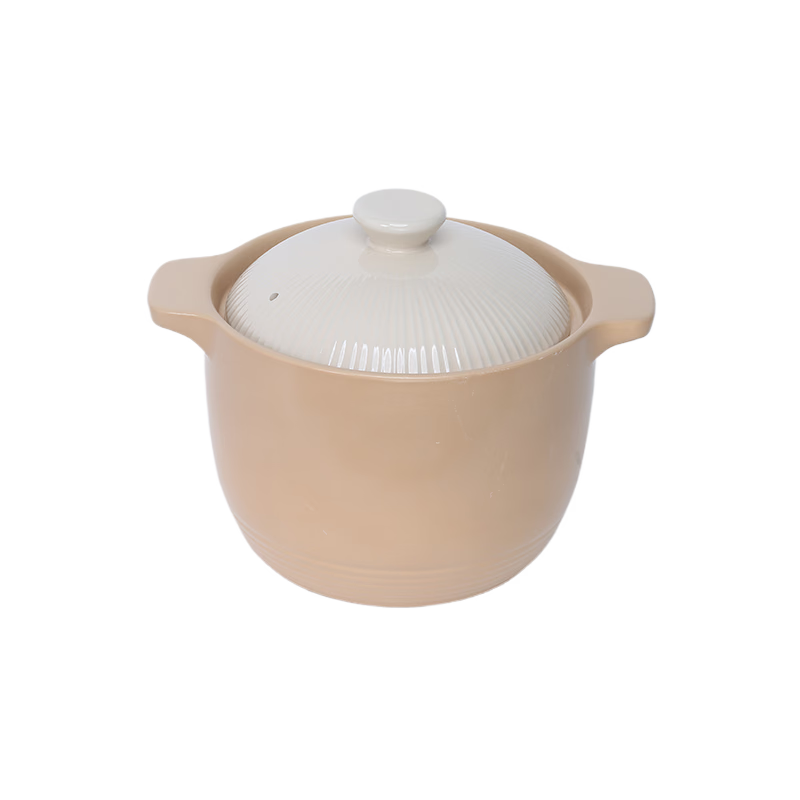
Start with a real model
Our IH collection includes casseroles, a pan and a shallow plate. The 6003-11-15-GI casserole is listed at 2.5 L; the 6032-11-15-GI shown here is listed at 4.5 L.
Use an existing model to anchor discussions of capacity, form and finish before adding custom development.
View the 2.5 L casserole →- Define the customer: target country, retail channel, intended dishes and price positioning.
- Name the cooking system: proposed hob models, cooking zones and intended operating conditions.
- Shape the collection: capacity, form, glaze palette, lid, decoration and packaging.
- Agree the evidence: sample criteria, compatibility checks, food-contact documentation and approved care instructions.
A focused brief lets the OEM/ODM development process connect a market idea with a specification that purchasing, design and quality teams can review together.
Questions buyers ask about IH ceramic cookware
Can ceramic cookware work on an induction hob?
Yes, when the product is specifically designed for induction. Sunshine describes its IH range as using a specially formulated ceramic body without a separately bonded metal base plate. Confirm compatibility for the exact cookware and hob combination; do not extend that claim to conventional ceramic cookware.
Is IH ceramic the same as ceramic-coated metal cookware?
No. A ceramic-bodied vessel and a metal pan with a ceramic coating are different constructions. Ask for the body material, food-contact surface and induction design, rather than using “ceramic” as a complete specification.
Does induction compatibility prove better efficiency or lower emissions?
No. Compatibility is not an efficiency measurement. An efficiency claim needs a defined test method and conditions; an emissions comparison also needs energy-supply and life-cycle boundaries. Product-specific evidence is required before making either claim.
Bring ceramic to your next induction-ready range.
Send your target market, reference model, capacity, intended hob and estimated quantity. We can discuss the product direction, sample requirements and information needed for an OEM/ODM quotation.
Discuss an IH ceramic cookware projectReferences
Updated 17 November 2026. Sources accessed 17 November 2026. Market context, company technical descriptions and product test results are different evidence types. References below do not certify Sunshine products.
- U.S. Environmental Protection Agency, ENERGY STAR. Electric Cooking Products. Buying guidance on induction and compatible cookware. View source ↗
- International Energy Agency. Sheltering From Oil Shocks: Cooking fuels. Paris: IEA; 2026. Electric-cooking options, equipment availability and grid capacity. View source ↗
- National Kitchen & Bath Association. NKBA | KBIS Releases Annual 2026 Kitchen Trends Report. 18 September 2025. Industry-survey expectations; not a cookware sales forecast. View source ↗
- International Energy Agency. Electricity 2025: Emissions. Paris: IEA; 2025. Power-generation emissions context. View source ↗
- Chaozhou Publishing (潮州发布). 236家潮州企业参加广交会二期 [236 Chaozhou enterprises attend the second phase of the Canton Fair]. 28 April 2024. Republished by Sina Finance. Includes a first-hand interview with Sunshine technician Wang Yongtao; not independent testing or an industry-first assessment. Chinese. View source ↗
- U.S. Food and Drug Administration. Questions and Answers on Lead-Glazed Traditional Pottery. November 2010. Finished-ceramic food-contact considerations. View source ↗